HydroGenie “Wish” Hydrogen Inhaler
A simpler, value-led Brown’s Gas inhaler, water-infusion, and direct-application device for users who want to explore hydrogen inhalation without moving immediately into a higher-output premium machine.
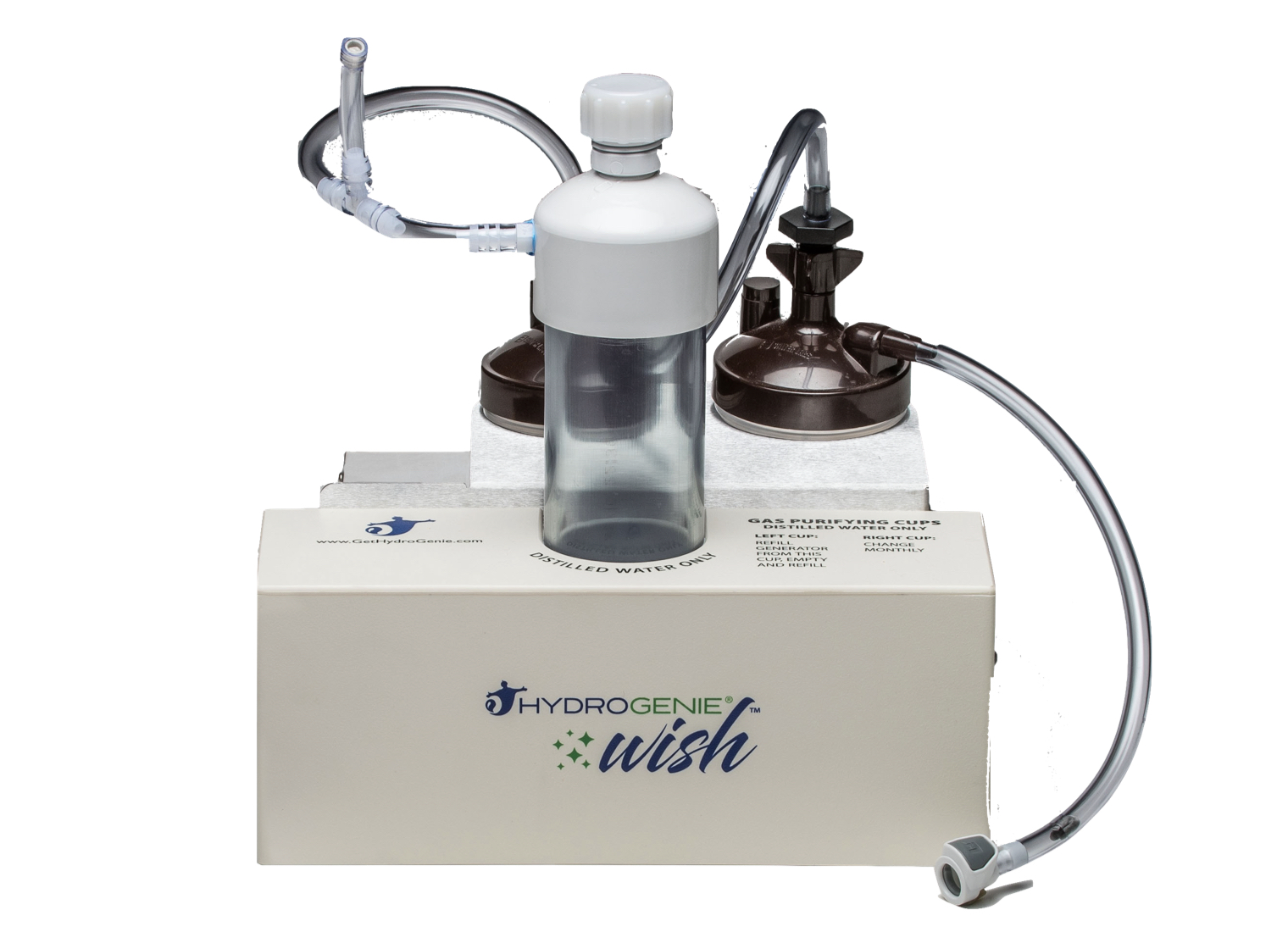
Product image: HydroGenie “Wish” Hydrogen Inhaler
Quick summary
The HydroGenie “Wish” Hydrogen Inhaler is the most accessible option within the H2|HPL® hydrogen inhaler Top Picks. It is best understood as a simpler Brown’s Gas inhalation, water-infusion, and direct-application device for users who want to explore hydrogen inhalation without moving immediately into a higher-output premium machine.
Its appeal is simplicity and value. Unlike the HX900 Pure Hydrogen Inhaler, which offers pure H2, Brown’s Gas, and PULSE functionality, or the H2 Respire 1000, which is built more like a high-capacity clinic-style workstation, the HydroGenie Wish focuses on a more modest and approachable use case.
The supplied data includes some conflicting capacity language, so this review takes the more cautious editorial position: the HydroGenie Wish should be treated as a 200–350 mL/min Brown’s Gas inhaler, with a recommended maximum use of around 2 hours before cool-down, and not as a continuous-use / 24-hour machine.
Why it made the H2|HPL® Top Picks list
The HydroGenie Wish made the H2|HPL® Top Picks list because it fills the value-led position within the hydrogen inhaler category.
Not every buyer needs a high-output, multi-mode inhaler. Some users may simply want a lower-complexity way to begin with Brown’s Gas inhalation, especially if they are still learning whether this type of appliance fits their routine.
The Wish offers that entry point. It provides Brown’s Gas inhalation, water infusion, and direct-application use through a simple accessory system, without the higher price and greater technical feel of the HX900 or H2 Respire 1000.
Its place in the Top Picks list is not based on being the most powerful inhaler. Instead, it earns its position because it is more approachable, simpler to understand, and better suited to users who want a cautious starting point.
What this system is designed to do
The HydroGenie Wish is designed to provide Brown’s Gas inhalation in a simpler home-use format.
The user adds electrolyte and distilled water, then uses the supplied nasal cannulas for inhalation. The unit is also supplied with an infusion stone and application cup, allowing it to be used for water infusion and direct topical-style application.
This makes it a “multi-use” device, but not in the same sense as the higher-end machines in this category. The HX900 offers multiple gas modes and PULSE delivery. The H2 Respire 1000 offers higher-capacity output, multi-user ports, touchscreen control, and advanced monitoring.
The Wish is more modest. Its purpose is to offer a simpler Brown’s Gas route for users who want to explore inhalation without the cost, weight, or complexity of a premium system.
It should also be used with realistic session expectations. Based on the safer product wording, this is not a continuous-use unit and should be allowed to cool down after sessions of up to around 2 hours.
Who this product may suit
The HydroGenie Wish may suit buyers who want a lower-cost entry point into hydrogen inhalation.
It may appeal to users who feel that the HX900 or H2 Respire 1000 are more advanced than they currently need. For someone who wants to begin with a simpler Brown’s Gas device, the Wish is easier to understand and less intimidating.
- Wants a lower-cost entry point into hydrogen inhalation
- Prefers a simpler Brown’s Gas-focused device
- Does not need pure H2 mode or PULSE modulation
- Wants an appliance that can support inhalation, water infusion, and direct application
- Plans to use the machine for occasional or structured short sessions
- Is comfortable following runtime guidance and cool-down periods
The Wish may be particularly suitable for occasional or structured short-session use, where the buyer is comfortable following runtime guidance and allowing the unit to cool down properly between sessions.
Who may be better starting elsewhere
Buyers who specifically want pure hydrogen inhalation may be better looking at the HX900 Pure Hydrogen Inhaler or the H2 Respire 1000 Clinical Grade Pure H2 & Brown’s Gas Inhalation Machine. The Wish is better framed as a Brown’s Gas-focused product.
Users who want high output, longer session flexibility, or a more advanced feature set may also be better suited to the HX900. The HX900 offers pure H2, Brown’s Gas, and PULSE modulation, giving it more range for structured daily use.
- Specifically wants pure H2 inhalation
- Needs high output or longer session flexibility
- Wants PULSE delivery or multiple gas modes
- Needs clinic-style multi-user capability
- Plans long, repeated, or continuous sessions
- Does not want to manage electrolyte and distilled water
Clinics, families, or serious multi-user households may be better looking at the H2 Respire 1000. That machine is much larger and more expensive, but it offers higher output, multiple gas ports, touchscreen controls, a larger tank, and more advanced safety monitoring.
Key features and what they mean
Brown’s Gas inhalation
The HydroGenie Wish is centred on Brown’s Gas inhalation rather than pure H2 inhalation. For buyers, this means it should not be compared directly with pure-hydrogen machines on the basis of H2-only delivery.
200–350 mL/min output range
The safer editorial reading of the product data is that the Wish delivers around 200 mL/min of Brown’s Gas, rising to approximately 350 mL/min after operating temperature is reached.
Limited runtime with cool-down requirement
One of the most important practical notes is that the HydroGenie Wish is not designed to run continuously. The supplied product text recommends a maximum of around 2 hours before cool-down.
Simple on/off operation
The Wish has a simpler control profile than the other H2|HPL® inhaler Top Picks. This may help buyers who want fewer settings and less technical management.
3-in-1 accessory use
The Wish comes with accessories for inhalation, water infusion, and direct application, including nasal cannulas, an infusion stone, an application cup, an extension hose, electrolyte, and a manual.
Voltage selection for worldwide use
The product can ship for 110v/60hz or 220v/50hz use, with no transformer needed when the correct version is specified. International buyers should confirm the correct voltage before ordering.
How it compares within the H2|HPL® Top Picks
Within the H2|HPL® inhaler Top Picks, the HydroGenie “Wish” Hydrogen Inhaler is the most accessible and straightforward option. It does not compete directly with the HX900 Pure Hydrogen Inhaler or the H2 Respire 1000 Clinical Grade Pure H2 & Brown’s Gas Inhalation Machine on raw output, advanced controls, or extended-use capability. Instead, its role is to offer a simpler entry point into Brown’s Gas inhalation.
HydroGenie “Wish” Hydrogen Inhaler
The Wish is the value-led option. It may suit buyers who want to begin with Brown’s Gas inhalation and water infusion without the cost or complexity of a higher-output inhaler.
HX900 Pure Hydrogen Inhaler
Compared with the HX900, the HydroGenie Wish is more limited. The HX900 offers pure hydrogen delivery, Brown’s Gas output, PULSE modulation, higher gas flow, and a more complete desktop inhalation profile.
The Wish is better understood as a lower-complexity Brown’s Gas unit for users who want a more affordable way to explore inhalation without stepping immediately into premium machine territory.
H2 Respire 1000
Compared with the H2 Respire 1000, the Wish is much smaller in ambition. The H2 Respire 1000 is a high-output, clinic-style hybrid inhalation workstation with multiple output lines, extended runtime, touchscreen controls, and advanced safety monitoring.
The Wish is more modest: simpler controls, lower flow, and a clear need for session limits and cool-down time.
Practical ownership notes
The HydroGenie Wish should be treated as a structured short-session machine, not a continuous-use inhaler.
The most important ownership habit is respecting the runtime guidance. Sessions should be kept within the recommended window, and the machine should be allowed to cool down before further use.
Buyers should also be comfortable using electrolyte and distilled water. This makes the Wish slightly different from machines that only require distilled water, and it means users need to follow the setup instructions carefully.
Because the Wish is simpler than the HX900 or H2 Respire 1000, it may be easier to operate day to day. However, that simplicity also means fewer built-in controls, fewer advanced modes, and less flexibility.
The accessory kit gives it useful range, but users should still decide whether their main interest is inhalation, water infusion, or topical application before buying. If the priority is serious high-output inhalation, the other two H2|HPL® Top Picks are stronger candidates.
Strengths
The HydroGenie Wish’s main strength is accessibility. It gives users a way into Brown’s Gas inhalation without requiring the higher financial commitment associated with the HX900 or H2 Respire 1000.
Its operation appears deliberately simple, with a basic on/off approach rather than a more complex touchscreen or multi-mode interface. This may appeal to users who feel overwhelmed by higher-spec inhalers.
The included accessory set gives it useful versatility. With nasal cannulas, an infusion stone, an application cup, extension hose, electrolyte, and manual, it supports inhalation, water infusion, and topical/direct application use.
It may also suit buyers who do not need high-volume output. For occasional or introductory use, the more modest 200–350 mL/min Brown’s Gas output may be enough, provided expectations are realistic.
Compared with the H2 Respire 1000, it is likely to feel far easier to place, store, and manage in a normal home environment.
Limitations and trade-offs
The main trade-off is runtime. The HydroGenie Wish should be treated as a limited-session machine, not a continuous-use inhaler. The safer editorial position is to describe it as suitable for up to around 2 hours of use before cool-down, rather than as a 24/7 unit.
Its output is also more modest than the other two H2|HPL® inhaler Top Picks. At around 200 mL/min, rising up to approximately 350 mL/min after warm-up, it does not match the HX900’s higher-flow pure hydrogen/Brown’s Gas flexibility or the H2 Respire 1000’s clinical-grade output.
It does not offer pure hydrogen mode in the same way as the HX900 or H2 Respire 1000. Buyers specifically looking for pure H2 inhalation should compare those two machines more closely.
The simpler design may also mean fewer smart protections, fewer controls, and less session customisation than the more advanced alternatives.
For users who already know they want longer sessions, family use, professional use, or advanced monitoring, the Wish may be too limited. In that case, the HX900 or H2 Respire 1000 would likely be stronger long-term options.
Questions to check before buying
Before buying the HydroGenie Wish, it is worth checking a few practical points.
- Are you happy with a Brown’s Gas-focused machine rather than a pure H2 inhaler?
- Will the 2-hour maximum before cool-down feel limiting for your intended use?
- Is the 200–350 mL/min output range enough, or would a higher-output model suit you better?
- Have you checked the correct voltage version before ordering?
- Are you comfortable using electrolyte and distilled water as part of the setup routine?
- Is your main interest inhalation, water infusion, or direct application?
- Would the HX900 or H2 Respire 1000 be a stronger match for your actual use pattern?
H2|HPL® editorial verdict
The HydroGenie “Wish” Hydrogen Inhaler is the most approachable option within the H2|HPL® inhaler Top Picks.
Its role is clear: it gives users a simpler, more value-led way to begin with Brown’s Gas inhalation, while also offering water infusion and direct-application accessories. It is not designed to compete with the HX900 or H2 Respire 1000 on advanced controls, output, or extended-use capability.
The most important buyer consideration is expectation-setting. The Wish should be viewed as a limited-session Brown’s Gas machine with a cautious 200–350 mL/min output range and a recommended maximum of around 2 hours before cool-down.
For users who want an accessible starting point, that may be enough. For users who want pure H2 inhalation, higher flow, longer sessions, or clinic-style performance, the HX900 or H2 Respire 1000 will be stronger comparisons.
Best fit: buyers looking for a simpler, lower-complexity Brown’s Gas inhaler for introductory or occasional structured use.
Product CTA
View the HydroGenie “Wish” Hydrogen Inhaler through the HydroGenie retail partner link below.
View product →Available via HydroGenie
Editorial note / disclosure
H2|HPL® product reviews are written as editorial buyer-assessment guides. They are designed to help readers compare product types, features, suitability, and ownership considerations before purchasing.
This review is based on supplied product information, category comparison, and editorial assessment. It should not be read as medical advice, a treatment recommendation, or a claim that this product can diagnose, treat, cure, or prevent disease.
Users with medical conditions, respiratory concerns, or ongoing treatment plans should seek appropriate professional guidance before using hydrogen inhalation equipment.
This page may include affiliate links. If you choose to purchase through one of these links, H2|HPL® may receive a small commission at no extra cost to you. This helps support the running of the site and the creation of independent educational content.